
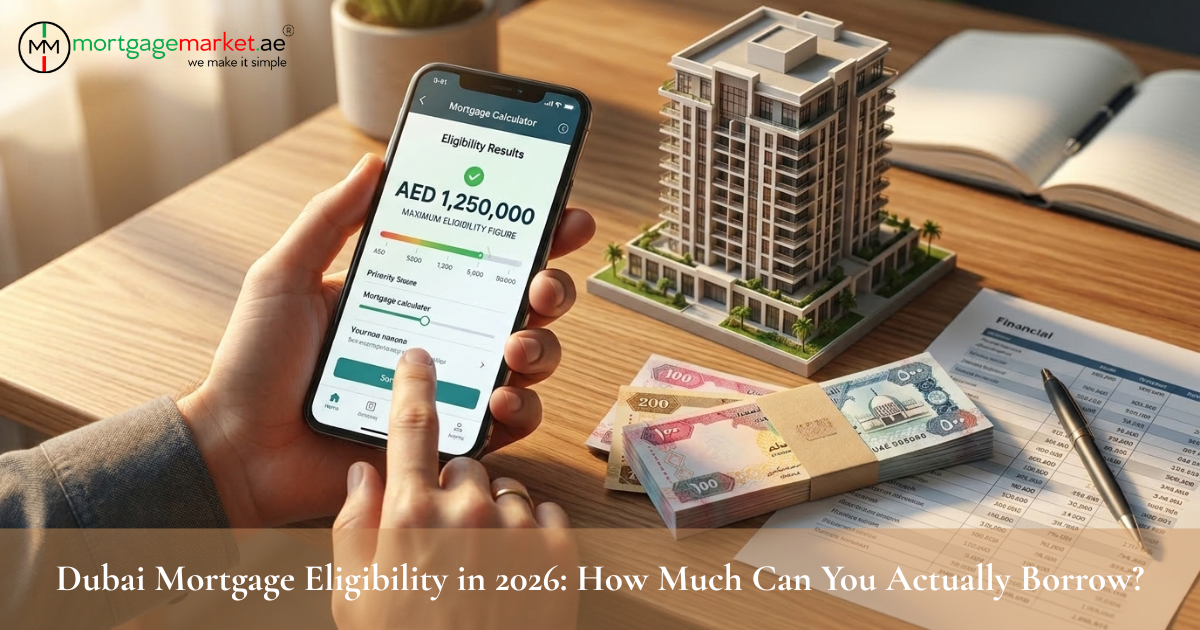
Dubai Mortgage Eligibility in 2026: How Much Can You Actually Borrow?
Buying property in Dubai in 2026? The bank's number is almost always different from the one you calculated—and the gap comes down to three rules most buyers have never seen explained. This guide covers exactly what determines your Dubai mortgage ceiling, with real AED figures.
You have found a property. You know the price. Now you need the answer to one question — will the bank lend you enough to buy it?
At Mortgage Market, we have been arranging mortgages across Dubai and the wider UAE for over 15 years. We have helped more than 1,000 clients secure financing across AED 3 billion in property purchases. The question above — how much can I actually borrow — is the one our advisors answer before anything else. Not as a rough estimate. As a precise calculation based on the rules every UAE bank is required to follow.
This guide walks you through exactly how that calculation works. If you want your number now, use the mortgage eligibility calculator in Dubai that our team built — it applies the same UAE Central Bank rules the banks use and returns your figure across leading lenders instantly. If you want to understand what the number means and what drives it, read on.
What Banks Are Actually Asking When You Apply
Most buyers approach a mortgage application with one number in mind — a monthly payment they can comfortably afford. Banks approach the same application with three separate regulatory tests, each producing a ceiling. Your approved loan amount is whichever ceiling is lowest.
The three tests are set by the UAE Central Bank. Every bank in the market applies them identically — there is no lender that can override them for a preferred client or a strong salary. Understanding all three is not optional knowledge for a Dubai buyer in 2026. It is the foundation of every property purchase decision.
● Debt Burden Ratio — what percentage of your income is already committed to debt
● Loan to Value ratio — what percentage of the property's price the bank will finance
● Stress test — whether you can afford the mortgage if interest rates rise significantly
The gap between what buyers expect to borrow and what banks approve almost always comes from misunderstanding one of these three — usually the stress test, which is the one nobody explains upfront.
Your Income — What the Bank Will and Will Not Count
Before any of the three tests run, the bank establishes your verified gross monthly income. Not the figure you state on the application form. The figure your documentation proves across payslips, salary certificates, and bank statements — consistently.
For most salaried employees on permanent contracts, this is a simple process. For everyone else, the rules are more specific.
Commission and variable pay
UAE banks typically count 50 to 60 percent of average commission or bonus income toward your mortgage eligibility salary. The average runs across 12 to 24 months. If your variable income fluctuates significantly year to year, the bank applies the lower end of that range. A buyer with AED 15,000 basic and AED 10,000 average monthly commission does not have AED 25,000 counted in their eligibility assessment — they typically have AED 20,000 to AED 21,000.
This matters because a AED 4,000 to AED 5,000 difference in the income figure used changes the maximum loan by AED 250,000 to AED 400,000 at current rates. When Mortgage Market advisors prepare a client's application, establishing the most defensible income figure — using the right documentation and averaging methodology — is one of the first things we address.
Self-employed and business owners
If you run a business in Dubai, the bank assesses your income based on audited accounts over 2 to 3 years — specifically net profit after drawings, not turnover or gross revenue. A business generating AED 5 million annually but declaring AED 35,000 per month in net profit is assessed at AED 35,000. The structure that minimises declared profit for operational reasons directly reduces mortgage eligibility.
Self-employed applicants benefit most from working with a finance broker in Dubai who knows which lender assesses business income most favourably for their specific structure — because the approach varies meaningfully across banks.
Rental income and overseas earnings
UAE rental income is typically accepted at 70 to 80 percent of the documented rental amount, with evidence through tenancy contracts and bank statement credits. Overseas income is treated inconsistently across lenders — some include it at a discount, others exclude it entirely. If overseas income is a significant part of your picture, the choice of lender matters considerably.
Your Existing Debts — The Number That Surprises Most Buyers
The Debt Burden Ratio is the UAE Central Bank's primary eligibility control. It states that your total monthly debt repayments — including the new mortgage — cannot exceed 50 percent of your gross monthly income at any point.
This sounds manageable until you see how much of that 50 percent has already been consumed before the mortgage enters the calculation.
What counts as monthly debt in the bank's calculation
Every active loan repayment — personal loans, car loans, education loans. All counted in full. The figure that consistently catches buyers off guard is credit cards.
Banks do not count what you owe on your credit cards, or what you typically pay each month. They count 5 percent of your total credit limit as a fixed monthly obligation — regardless of your balance or payment behaviour. If you carry AED 80,000 in credit limits across four cards and pay the full balance every month, the bank adds AED 4,000 to your monthly debt commitments in the DBR. That is 20 percent of a AED 20,000 salary's DBR allowance — gone before the mortgage is considered.
In our experience at Mortgage Market, this is the single most common reason buyers qualify for less than they expected. Not insufficient salary — unconsidered credit limits.
|
DBR Step-by-Step — AED 20,000 Monthly Salary Gross monthly salary: AED 20,000 50% DBR ceiling (max total monthly debt): AED 10,000 Car loan repayment: AED 1,500 / month Credit card obligations (5% of AED 30,000 limits): AED 1,500 / month Total existing debt: AED 3,000 / month Available for mortgage repayment: AED 7,000 / month Approximate max loan at 4.5% over 25 years: AED 1.25 million Same profile — car loan cleared, card limits halved: AED 1.55 million+ |
The practical action is clear. Reducing credit card limits and clearing existing loans before applying directly improves your eligibility — sometimes by AED 200,000 to AED 400,000 on the same salary. Run your own numbers through the eligibility calculator to see the difference in your specific situation. If the result is lower than you need, our advisors at Mortgage Market will tell you exactly what to change and by how much.
Your Down Payment — How LTV Determines What the Bank Will Finance
The Loan to Value ratio sets the maximum percentage of a property's price the bank will lend you. The rest is your down payment. These limits are UAE Central Bank requirements — identical at every lender in the market.
|
Buyer Category |
Maximum LTV / Minimum Down Payment |
|
UAE National — First home under AED 5M |
85% LTV — 15% down payment |
|
UAE National — First home over AED 5M |
75% LTV — 25% down payment |
|
UAE National — Investment property |
65% LTV — 35% down payment |
|
Expatriate — First home under AED 5M |
80% LTV — 20% down payment |
|
Expatriate — First home over AED 5M |
70% LTV — 30% down payment |
|
Expatriate — Investment property |
60% LTV — 40% down payment |
|
Off-plan property — all categories |
50% LTV — 50% down payment |
Two points from this table that come up regularly in our client conversations.
First, the off-plan row. Buying a property under construction — regardless of your nationality, income, or credit profile — means a maximum of 50 percent financing. An AED 2 million off-plan apartment requires AED 1 million in cash. Buyers who calculate their eligibility based on ready property rules are consistently surprised by this when they try to finance an off-plan purchase.
Second, the bank applies the LTV to their own independent valuation of the property — not the price you agreed with the seller. If you pay AED 1.6 million for a property the bank values at AED 1.5 million, the 80 percent LTV applies to AED 1.5 million. The AED 100,000 shortfall comes from your own funds. Mortgage Market advisors flag this risk before clients commit to a price — because discovering it after signing a sale agreement is significantly more expensive.
The Stress Test — The Rule That Reduces Borrowing Most
This is the calculation that produces the biggest gap between what buyers expect and what banks approve — and the one that almost no one explains upfront.
UAE Central Bank regulations require banks to assess every mortgage application at a rate 2 to 4 percentage points above the current interest rate. The bank is not checking whether you can afford the mortgage at today's rate. It is checking whether you can still afford it if rates rise significantly. Your DBR must pass at that higher rate — not at the rate you will actually pay.
In 2026, with EIBOR rates stabilising near 3.5 percent and fixed mortgage products sitting around 4 to 4.5 percent, banks are stress testing at approximately 6.5 to 8 percent. If your monthly repayment at the stress test rate pushes your total debt above 50 percent of your income, the bank declines the loan at that amount — even though you can comfortably afford the actual repayment.
|
What the Stress Test Does to Your Monthly Repayment Loan: AED 1,500,000 over 25 years At your actual rate (4.5%): AED 8,300 per month At stress test rate (7%): AED 10,600 per month The bank tests your DBR against: AED 10,600 — not AED 8,300 If AED 10,600 exceeds your DBR ceiling, the loan is declined at this amount even though you will never actually pay AED 10,600. The stress test is designed to protect you from future rate rises — but it reduces your approved amount today. |
Knowing this, the practical response is to work backwards from the stress test rate when setting your property search budget — not from the current rate. Our advisors at Mortgage Market calculate both figures for every client before they begin viewing properties. There is no point falling in love with a AED 2 million apartment if the stress test means your approval ceiling is AED 1.7 million.
Three Things That Cut Your Borrowing Power Without Being Obvious
What reduces your eligibility without being obvious
1. Credit limits you do not use. Banks add 5% of your total credit limit to monthly obligations regardless of what you owe. AED 100,000 in card limits adds AED 5,000 per month to your DBR commitments. Reduce limits you do not need at least 90 days before applying — changes take time to update in the Al Etihad Credit Bureau.
2. Age and loan term interaction. Expatriate salaried employees must have their mortgage mature before age 65 (70 for UAE nationals and self-employed). A 50-year-old expatriate cannot take a 25-year term — their maximum is 15 years. AED 1.5 million over 15 years at 4.5% produces AED 11,400 per month. That higher repayment goes through the stress test — and often fails a DBR that the 25-year version would have passed.
3. Being a guarantor on someone else's loan. If your name appears as guarantor on another party's financing — a family member, a business partner — that loan's repayment is partially counted against your DBR. Review all guarantees before applying. In some cases, requesting removal as guarantor before your mortgage application meaningfully changes your eligibility calculation.
How to Improve Your Eligibility Before You Apply
Your eligibility at any given moment is not fixed. These are the specific actions that move the number — ranked by how much impact they typically have.
● Reduce credit card limits. Each AED 10,000 reduction in total limits removes AED 500 from your monthly DBR obligations. On a AED 20,000 salary, reducing total limits from AED 80,000 to AED 40,000 adds AED 2,000 to your available mortgage repayment capacity. Allow 90 days for the change to register in the credit bureau before applying.
● Clear existing loans. Paying off a personal loan or car loan removes the entire monthly repayment from your DBR. A loan with 18 months remaining at AED 2,000 per month — even if you plan to pay it off eventually — is adding AED 2,000 to your monthly debt in the bank's calculation right now. Clear it first.
● Increase your down payment. A larger down payment reduces the loan amount, which reduces the monthly repayment, which makes the DBR and stress test calculations easier to pass. If the stress test is your binding constraint, sometimes adding AED 50,000 to AED 100,000 to the down payment moves the monthly payment below your ceiling.
● Time your application after a salary increase. A higher salary increases the DBR ceiling directly. If a salary review or promotion is imminent, applying after it rather than before typically produces a materially better result.
● Add a co-applicant. Adding a spouse or qualifying family member increases the combined income base for the DBR calculation. Both applicants' debts are also combined — this only improves eligibility if the co-applicant's income contribution exceeds their debt contribution.
What Individual Banks Add on Top of Central Bank Rules
The DBR, LTV, and stress test are the UAE Central Bank floor. Every bank applies additional criteria above these. The differences across lenders are more significant than most buyers expect — and they are one of the core reasons why working with a mortgage broker in Dubai produces materially better outcomes than approaching banks directly.
Minimum salary thresholds
Most UAE banks require a minimum monthly salary of AED 15,000 for expatriate mortgage applicants. Some set this higher — AED 20,000 to AED 25,000 for certain products or loan amounts. UAE nationals typically qualify from around AED 10,000 to AED 12,000 per month. This is a separate threshold from the DBR — passing the DBR calculation does not guarantee you meet a bank's minimum salary requirement.
Employment duration requirements
Most banks require a minimum of 6 months in your current role for salaried employees. Some require 12. If you recently changed jobs — even for a significantly higher salary — some banks will decline the application while others will accept it. This is one of the most consequential bank-by-bank differences. A mortgage consultant in Dubai who knows each lender's current stance on this can save a buyer from a declined application that damages their credit score.
Al Etihad Credit Bureau score
Every UAE resident with a financial history has a credit score. Banks check it at application. A strong score — generally above 700 — supports both eligibility and the interest rate offered. Late payments, defaults, and high credit utilisation reduce the score and can affect approval even when the DBR and LTV calculations pass. Check your score at least three months before you plan to apply — it is free through the AECB app and gives you time to address any issues before they affect an application.
What the Numbers Produce in Practice — Three Real Scenarios
These are based on 2026 rates and UAE Central Bank rules. Actual outcomes depend on your specific documentation and the bank's criteria.
Expatriate, AED 20,000 salary, no existing debt, buying first home
● DBR ceiling: AED 10,000 per month
● Stress test rate: approximately 7%
● Maximum monthly payment at stress test: AED 10,000
● Approximate maximum loan: AED 1.35 million over 25 years
● With 20% down payment: can consider properties up to AED 1.69 million
Expatriate, AED 35,000 salary, AED 3,500 per month in existing debt
● DBR ceiling: AED 17,500 per month
● Existing debt reduces available capacity to: AED 14,000
● Approximate maximum loan: AED 1.9 million over 25 years
● With 20% down payment: can consider properties up to AED 2.37 million
UAE National, AED 25,000 salary, AED 2,000 per month in existing debt
● DBR ceiling: AED 12,500 per month
● Existing debt reduces available capacity to: AED 10,500
● Approximate maximum loan: AED 1.42 million over 25 years
● With 15% down payment: can consider properties up to AED 1.67 million
These scenarios are illustrations. Your figure depends on your specific income structure, existing commitments, credit profile, and target property type. The Mortgage Market eligibility assessment produces your precise number across five leading UAE banks — not an approximation.
Getting Pre-Approved — What It Takes and Why It Matters
A pre-approval letter from a bank states the exact amount they are prepared to lend you before you have found a specific property. In Dubai's 2026 market, pre-approved buyers are treated differently by sellers and developers. They move faster, negotiate from a position of certainty, and do not lose properties to other buyers while their financing is still being worked out.
Pre-approval typically takes 3 to 7 working days with complete documentation. The letter is usually valid for 60 to 90 days. Here is what you need to prepare:
|
Documents for Dubai Mortgage Pre-Approval |
|
✓ Passport — valid, full copy including all pages ✓ UAE residence visa — current ✓ Emirates ID — front and back copy ✓ Salary certificate — on company letterhead, dated within 30 days ✓ Last 3 months payslips ✓ Last 6 months personal bank statements — showing salary credit ✓ For self-employed: 2–3 years audited accounts, trade licence, 12 months business bank statements ✓ Existing loan statements — outstanding balance and monthly repayment for each |
Once your documents are ready, the fastest path to a pre-approval letter is through the Mortgage Market team. We identify the right lender for your profile, handle the submission, and manage the process from application to letter. Contact us to get started — or submit your documents directly and we will come back to you with a full assessment.
Why the Choice of Lender Matters More Than Most Buyers Realise
Every bank in the UAE applies the same UAE Central Bank floor rules. What differs — and differs significantly — is how each lender handles the cases that sit between straightforward approval and straightforward decline.
Bank A counts 100 percent of rental income. Bank B counts 70 percent. Bank A applies a 2 percent stress test buffer. Bank B applies 4 percent. Bank A requires 6 months in role. Bank B requires 12. Bank A accepts self-employed income from 2 years of audited accounts. Bank C requires 3. The same buyer produces materially different maximum loan figures at different banks — sometimes by AED 200,000 to AED 400,000 on the same profile.
A mortgage broker in Dubai who works across the full market — not tied to any single lender — positions your application at the bank where your specific profile performs best. At Mortgage Market, that is precisely what our team does. We compare mortgage products in Dubai across every major lender, assess your profile against each bank's current criteria, and submit to the lender where your eligibility is strongest and the terms are most competitive.
In a market where the best and average mortgage rates in Dubai on a AED 1.5 million loan over 25 years can differ by AED 50,000 to AED 80,000 in total interest, the lender choice is not a minor detail. It is one of the most consequential financial decisions in the entire property purchase process. Speak to the Mortgage Market team before you commit to any lender or product.
Questions Our Advisors Hear Most
What is the minimum salary for a Dubai mortgage in 2026?
Most UAE banks require a minimum monthly salary of AED 15,000 for expatriate applicants. Some set this higher for certain products. UAE nationals typically qualify from around AED 10,000 to AED 12,000 per month. The minimum salary threshold is separate from the DBR calculation — you need to pass both. A buyer who earns above the minimum but has high existing debt may still face eligibility constraints at the DBR level even if they clear the minimum salary test.
How accurate is an online mortgage calculator?
A mortgage calculator in Dubai applies the Central Bank's regulatory rules to your inputs and returns an approximate maximum loan figure. It is accurate as a starting point — the rules it applies are the same rules every bank uses. What it cannot account for is bank-specific criteria, income documentation nuances, and your full credit profile. Use it to understand your approximate position, then validate with a Mortgage Market advisor before making any property offers.
What is EIBOR and how does it affect my mortgage rate?
EIBOR is the Emirates Interbank Offered Rate — the benchmark that variable-rate mortgages in Dubai are priced against. A typical variable product is structured as a margin above 3-month or 1-month EIBOR. As EIBOR moves, your rate and monthly payment move with it. Fixed-rate products lock your rate for an initial period — typically 1 to 5 years — before reverting to a variable rate. With EIBOR rates near 3.5% in 2026, understanding how rate movement affects your monthly repayment is part of choosing the right product structure for your situation.
Can a non-resident get a mortgage in Dubai?
Yes. Non-residents can access mortgage financing for freehold properties in Dubai. LTV limits are more restrictive — typically 50 to 60 percent, requiring a 40 to 50 percent down payment. Interest rates are generally higher than for UAE residents. Not all banks offer non-resident products. If you are buying as a non-resident, identifying the right lenders from the outset — rather than approaching banks individually — is particularly important.
What happens if I want to refinance my existing Dubai mortgage?
Refinancing — moving your existing mortgage to a new lender at better terms — is assessed against the same DBR, LTV, and stress test rules as a new mortgage. The question is whether the saving from a lower rate outweighs the costs of moving: early settlement fees, valuation fees, and new arrangement charges. Use the Mortgage Market buyout calculator to run the numbers before making any decision. Our advisors work through the full cost comparison with you — so you only refinance when it genuinely makes financial sense.
How long does full mortgage approval take in Dubai?
Pre-approval — a conditional letter before you have a specific property — typically takes 3 to 7 working days with complete documentation. Full approval after you have a signed sale agreement takes a further 2 to 4 weeks depending on the bank, property type, and valuation. Off-plan purchases can take longer because the bank also assesses the developer and project. Having all your documents prepared before you start viewing properties is the single most effective way to compress this timeline.
What is the maximum mortgage term available in Dubai?
The UAE Central Bank caps the maximum term at 25 years. Your actual available term is further limited by age — for expatriate salaried employees, the mortgage must mature before age 65; for UAE nationals and self-employed applicants, the limit is typically 70. If you are over 40, your effective maximum term may be shorter than 25 years — which produces a higher monthly repayment and affects both your DBR calculation and your stress test outcome.
Your Next Step
Every Dubai mortgage application is assessed against three fixed regulatory calculations — DBR, LTV, and the stress test. Understanding all three before you start viewing properties means you search in the right price range, negotiate with certainty, and do not lose a property because your financing takes longer than expected.
The actions that improve your eligibility — reducing credit limits, clearing existing loans, timing your application correctly — are specific and measurable. They are not vague advice. They are calculations with AED outcomes that you can run before you decide what to do.
Mortgage Market has been helping Dubai buyers understand and improve their mortgage position for over 15 years. Use the eligibility calculator for an instant picture of your position across leading UAE banks. When you are ready for a precise assessment — one that accounts for your full income structure, existing commitments, and target property — the team is available to work through the numbers with you
Dubai Mortgage Eligibility in 2026: How Much Can You Actually Borrow?
Buying property in Dubai in 2026? The bank's number is almost.....
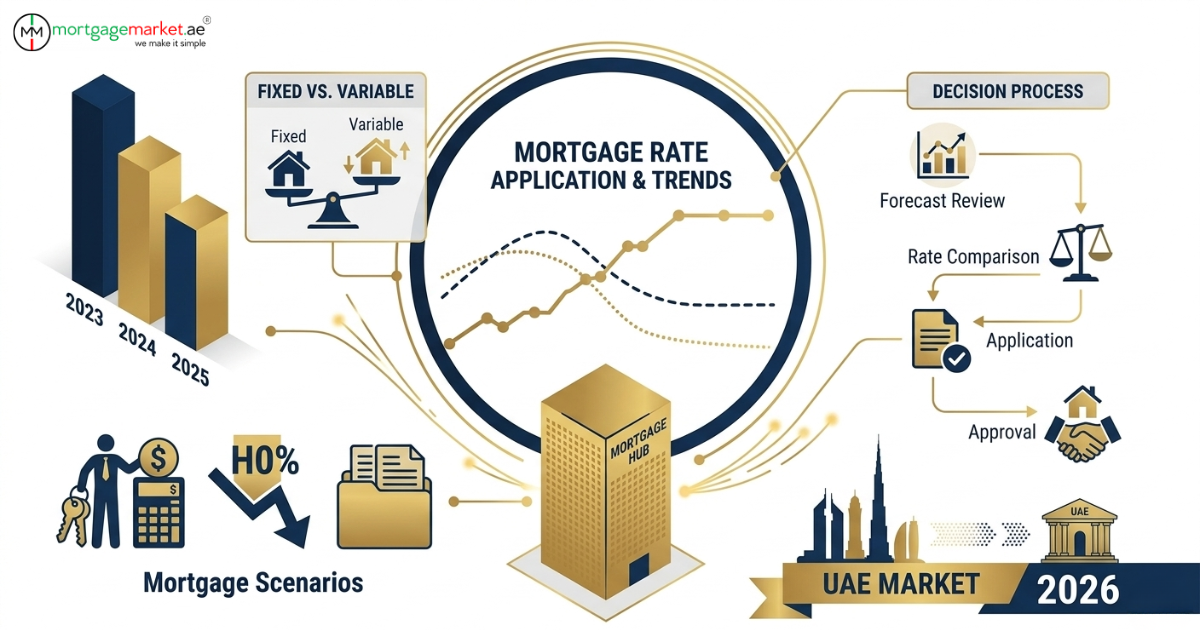
UAE Mortgage Rates 2026: Expert Interest Rate Forecast & EIBOR Trends
Discover the latest UAE mortgage rates in 2026 and.....

Know Your Mortgage Eligibility Instantly with Our Calculator
When it comes to buying a house or securing financing in the UAE, one of.....

Buyout Mortgage Magic: Instantly Find Your Limit
At the center of Dubai’s vibrant property market—where vision collides with creativity—hides a valuable weapon.....

Five Reasons Dubai Is a Safe Place to Buy Property | Mortgage Market
Dubai’s real property marketplace has long been a beacon for worldwide buyers, expats, and dreamers.....

How to make your funds go further and save on upfront fees?
Buying a property in Dubai is a thrilling milestone; however, the upfront costs—down payments, registration.....

EIBOR as on 30 Apr 2025: 1 MONTH: 4.26% | 3 MONTH: 4.24% | 6 MONTH: 3.99% | 1 YEAR: 4.17%