

Home Loan Interest Rates in Dubai — A Complete 2026 Guide
Quick Answer
Home loan interest rates in Dubai currently range from 3.95% to 5.99% per annum depending on the bank, visa type, and whether you choose a fixed or variable rate. Most banks offer a fixed introductory rate for 1 to 5 years, after which the rate moves to a variable rate linked to EIBOR. Using a mortgage broker in Dubai is the fastest way to compare all available rates in one place.
If you are planning to buy property in Dubai, the interest rate on your home loan is one of the most important numbers you will deal with. A difference of just 0.5% on a AED 2 million mortgage can mean paying tens of thousands of dirhams more over the life of the loan — or saving that same amount by choosing the right bank at the right time.
Yet for most buyers — whether first-time purchasers, expats, or investors — home loan interest rates in Dubai remain confusing. What is a fixed rate and what is a variable rate? What is EIBOR and why does it affect your monthly payment? Which bank currently offers the best mortgage rates in Dubai? And how do you know if the rate you have been offered is actually competitive?
This complete 2026 guide answers all of those questions clearly and honestly. By the end, you will know exactly how home loan interest rates in Dubai work, what to expect from the current market, and how to use a mortgage broker in Dubai to find the best deal available for your specific situation.
How Do Home Loan Interest Rates Work in Dubai?
Before comparing rates across banks, it is important to understand the structure of how home loan interest rates in Dubai actually work. Unlike some markets where a single rate applies for the full loan term, Dubai mortgage rates are almost always structured in two phases.
Phase 1 — The introductory fixed rate period
When you take out a home loan in Dubai, most banks will offer you a fixed interest rate for an initial period. This is typically one, two, three, or five years. During this period, your monthly payment stays the same regardless of what happens in the broader market. The fixed rate gives you certainty and predictability — you know exactly what you will pay each month.
The introductory fixed rates currently available in Dubai range from around 3.95% to 4.49% per annum for a three-year fixed period, depending on the bank and your profile. Some banks offer slightly lower rates for UAE nationals, and rates for non-residents tend to be higher — typically starting from 5.49% per annum.
Phase 2 — The variable rate linked to EIBOR
Once the introductory fixed period ends, your mortgage rate moves to a variable rate. This variable rate is calculated as a fixed margin set by your bank — typically between 1.00% and 2.00% — added on top of the EIBOR rate (Emirates Interbank Offered Rate). This is sometimes called the follow-on rate.
For example, if your bank offers a follow-on rate of 1.75% plus the 3-month EIBOR, and the 3-month EIBOR is currently 3.60%, your variable rate from year four onwards would be 5.35% per annum. If EIBOR falls, your rate falls. If EIBOR rises, your rate rises.
This is why the margin — the percentage your bank adds on top of EIBOR — matters just as much as the introductory fixed rate. A bank offering 3.99% fixed for three years with a 1.00% margin is a far better long-term deal than one offering 3.89% fixed with a 2.00% margin.
What Is EIBOR and How Does It Affect Your Home Loan Rate?
EIBOR stands for Emirates Interbank Offered Rate. It is the benchmark interest rate used across the UAE banking system, set daily based on the rates at which UAE banks lend money to each other. Most variable rate home loans in Dubai are directly linked to EIBOR — specifically the 1-month, 3-month, or 6-month EIBOR rate. You can check the latest EIBOR rates updated daily on Mortgage Market.
Current EIBOR rates (February 2026)
• 1-month EIBOR: 3.65%
• 3-month EIBOR: 3.60%
• 6-month EIBOR: 3.55%
• 1-year EIBOR: 3.72%
Most Dubai mortgage products are linked to the 3-month EIBOR. This means once your fixed introductory period ends, your rate will move up or down every quarter in line with changes to the 3-month EIBOR.
Why does EIBOR matter when choosing a home loan?
If you are taking out a mortgage today with a 3-year fixed rate, the EIBOR rate at the time you start does not affect your payments during the fixed period. However, what EIBOR is doing when your fixed period ends — and where it is expected to go — affects which type of mortgage product makes the most sense for you.
In a falling EIBOR environment, a shorter fixed period can be more advantageous because your variable rate from year two or three onwards could be lower than locking in for a longer fixed term today. In a rising EIBOR environment, a longer fixed period protects you.
Working with an experienced mortgage advisor in Dubai who tracks EIBOR trends helps you choose not just the best rate today, but the mortgage structure that is most likely to save you money over the full loan term.
Fixed Rate vs Variable Rate Home Loans in Dubai — Which Is Better?
This is one of the most common questions buyers ask when comparing home loan interest rates in Dubai. The honest answer is that neither is universally better — the right choice depends on your timeline, risk tolerance, and what EIBOR is expected to do.
Fixed rate home loans
A fixed rate home loan gives you a guaranteed interest rate for a set period — typically one to five years. Your monthly payment does not change during this period, making budgeting straightforward. Fixed rates in Dubai are currently between 3.95% and 4.49% per annum for a three-year term.
Fixed rates are best suited for buyers who want payment certainty, are on a tight budget, or are concerned that EIBOR could rise significantly before their loan matures.
The downside is that if EIBOR falls significantly during your fixed period, you will not benefit from lower rates until the fixed period ends. Some banks also charge early settlement or conversion fees if you want to switch out of a fixed rate early.
Variable rate home loans
A variable rate home loan is linked directly to EIBOR from day one. Your rate — and therefore your monthly payment — moves up or down in line with EIBOR changes. Variable rates are typically lower than fixed rates when EIBOR is low, but can rise significantly if EIBOR increases.
Variable rates are best suited for buyers who can absorb payment fluctuations, believe EIBOR will fall or stay stable, or plan to sell or pay off the property within a few years.
What most buyers choose in 2026
In the current market, the majority of buyers in Dubai are opting for a three-year fixed rate. EIBOR has been gradually declining from its 2023 peak, and most analysts expect it to continue trending downward in line with US Federal Reserve rate decisions. A three-year fixed rate locks in a competitive rate now while leaving you free to reassess and potentially switch banks when the fixed period ends.
Use the mortgage calculator to compare your monthly payments across fixed and variable rate options before making a decision.
Current Home Loan Interest Rates in Dubai — 2026
The following rates reflect current market offerings as of early 2026. Rates change regularly and vary based on your income, nationality, loan amount, and property type. Always verify the latest rates with a mortgage broker before making a decision.
Best 3-year fixed rates — UAE residents
• Dubai Islamic Bank (DIB): 3.95% fixed for 3 years | Follow-on: 1.00% + 3M EIBOR
• Commercial Bank of Dubai (CBD): 3.99% fixed for 3 years | Follow-on: 1.79% + 3M EIBOR
• ADIB: 3.99% fixed for 3 years | Follow-on: 1.60% + 1M EIBOR (min 3.10%)
Note: DIB has the lowest introductory rate, but CBD and ADIB have competitive follow-on margins. Over a 25-year loan, the follow-on margin matters significantly more than a 0.04% difference in the fixed period.
Best rates — non-residents
• Commercial Bank of Dubai: 5.49% fixed for 3 years | Follow-on: 2.79% + 3M EIBOR
• Mashreq Bank: 5.99% fixed for 2 years | Follow-on: 2.99% + 3M EIBOR
• Mashreq Bank (min rate): 5.75% fixed for 2 years | Follow-on: 2.99% + 3M EIBOR (min 2.99%)
Non-resident rates are higher because the bank carries more risk without a UAE salary or visa backing the loan. If you are a non-resident looking to buy property in Dubai, a mortgage broker in Dubai can identify which banks are currently most competitive for your specific nationality and income profile.
How do I compare mortgage rates properly?
Most buyers make the mistake of comparing only the introductory fixed rate. To compare home loan interest rates in Dubai properly, you need to look at three numbers together:
1. The introductory fixed rate — what you pay in years 1 to 3
2. The follow-on margin — what gets added to EIBOR from year 4 onwards
3. The fees — arrangement fees, valuation fees, and early settlement charges
The easiest way to do this across multiple banks at once is to use the mortgage comparison tool or speak with a mortgage consultant in Dubai who can run the numbers for your specific loan amount.
What Affects the Home Loan Interest Rate You Are Offered?
The rate advertised by a bank is not necessarily the rate you will receive. Several factors influence the actual rate offered to an individual borrower. Understanding these helps you improve your position before applying.
1. Your nationality and visa status
UAE nationals typically qualify for the most competitive home loan interest rates in Dubai. UAE resident expats with valid employment visas follow. Non-residents face the highest rates due to perceived repayment risk. Some banks have preferred nationalities based on historical repayment data.
2. Your income and debt burden ratio
UAE Central Bank regulations cap total debt repayments at 50% of monthly income for expats and 55% for UAE nationals. The more of your income that is already committed to existing debts — car loans, personal loans, credit cards — the lower your mortgage eligibility and the higher the rate you may be offered. Banks offer better rates to applicants with low debt-to-income ratios.
3. Loan-to-value ratio
The loan-to-value (LTV) ratio is the percentage of the property value you are borrowing. UAE regulations cap LTV at 80% for expats on their first property (meaning a 20% deposit minimum) and 85% for UAE nationals. Borrowers who put down a larger deposit — reducing the LTV — are seen as lower risk and may qualify for better rates.
4. Employment type — salaried vs self-employed
Salaried employees with a salary transfer to the lending bank typically receive the best available rates. Self-employed applicants face stricter documentation requirements and may be offered slightly higher rates due to the variable nature of their income. Some banks are more self-employed friendly than others — a mortgage broker can identify which.
5. Property type and location
Ready properties generally attract better rates than off-plan purchases. Properties in prime locations with strong resale markets — Downtown Dubai, Dubai Marina, Palm Jumeirah — are viewed more favourably by banks than properties in less established areas. Commercial properties and land purchases attract different rate structures entirely.
How to Calculate Your Monthly Home Loan Payment in Dubai
Once you know the interest rate you qualify for, the next step is calculating what your monthly payment will actually be. This depends on three variables: the loan amount, the interest rate, and the loan term.
Example calculation
Property value: AED 2,000,000
Deposit (20% for expats): AED 400,000
Loan amount: AED 1,600,000
Interest rate: 3.99% fixed for 3 years
Loan term: 25 years
Estimated monthly payment: approximately AED 8,400 per month
Total interest paid over 25 years at this rate: approximately AED 920,000
Use the mortgage calculator to run your own numbers instantly. You can adjust the loan amount, interest rate, and term to see exactly how each variable affects your monthly payment and total interest cost.
How much does a 0.5% rate difference actually cost?
On the same AED 1,600,000 loan over 25 years, the difference between a 3.99% rate and a 4.49% rate is approximately AED 450 per month — or AED 135,000 over the full loan term. This is why comparing home loan interest rates in Dubai properly, rather than accepting the first offer from your bank, makes a significant financial difference.
Am I Eligible for a Home Loan in Dubai?
Before comparing interest rates, it is worth confirming that you meet the basic eligibility requirements for a home loan in Dubai. Many buyers spend weeks comparing rates only to discover they do not qualify at the loan amount they need.
Basic eligibility requirements
• Minimum age: 21 years at time of application, maximum age at loan maturity typically 65 for expats and 70 for UAE nationals
• Minimum monthly income: AED 15,000 for most banks, though some accept AED 10,000
• Employment: minimum 3 to 6 months with current employer for salaried applicants
• Self-employed: minimum 2 years of audited accounts or business bank statements
• Credit history: clean UAE credit bureau (AECB) report with no defaults or missed payments
• Visa: valid UAE residence visa for resident applicants
Use the mortgage eligibility calculator to get an instant assessment of how much you can borrow across five leading UAE banks based on your income and existing commitments.
What if I do not meet the minimum requirements?
If your income is slightly below the minimum, or your employment tenure is shorter than required, not all banks will decline you. Different banks have different policies — some are more flexible on income thresholds, others accept shorter employment periods for applicants with strong credit profiles. A mortgage consultant in Dubai who knows each bank's current appetite can identify which lender is most likely to approve your specific situation.
Using a Mortgage Broker in Dubai — Why It Costs You Nothing and Saves You a Lot
One of the biggest misconceptions among property buyers in Dubai is that using a mortgage broker costs extra. It does not. Mortgage brokers in Dubai are paid by the banks, not by the borrower. The service is free to you — and it comes with significant advantages.
What a mortgage broker does
A mortgage broker in Dubai assesses your financial profile, identifies which banks are most likely to approve your application, and negotiates the best available rate on your behalf. Rather than you approaching each bank individually — completing multiple applications, submitting documents repeatedly, and comparing offers manually — the broker does all of this in one process.
Why brokers often get better rates than going direct
Mortgage brokers in Dubai handle significant loan volumes across multiple banks. This gives them negotiating leverage that an individual buyer does not have. Banks also have special broker-only products and promotions that are not available to walk-in customers. In many cases, the rate a broker secures is lower than what the same bank would offer you directly.
What to look for in a mortgage advisor in Dubai
• Experience — look for brokers with a minimum of 5 to 10 years in the UAE market
• Bank panel — a good broker has relationships with at least 8 to 10 UAE banks
• Transparency — they should show you all available options, not just one bank
• No pressure — a trustworthy mortgage consultant in Dubai advises, they do not push
• Track record — ask how many mortgages they have arranged and what their approval rate is
Mortgage Market has been operating in Dubai for over 15 years with a team of experienced relationship managers. Contact us to speak with a mortgage advisor who will assess your eligibility and find the best home loan interest rate available for your profile.
Already Have a Mortgage in Dubai? Your Rate May Be Too High
If you took out a home loan in Dubai two or more years ago, there is a good chance you are paying a higher rate than what is currently available in the market. This is especially true if your fixed introductory period has ended and you are now on a variable rate with a high EIBOR margin.
What is a mortgage buyout?
A mortgage buyout — also called a mortgage transfer or refinance — is the process of moving your existing home loan from your current bank to a new bank that offers a better rate. The new bank pays off your existing mortgage and issues you a new loan at the lower rate. Your monthly payment drops, and you save on total interest over the remaining loan term.
When does a mortgage buyout make sense?
• Your current rate is more than 0.5% above what is available in the market
• Your fixed rate period has ended and you are now on a high variable rate
• Your property value has increased significantly, giving you a lower LTV and better rate eligibility
• Your income has increased, improving your borrowing profile
Use the buyout calculator to see how much you could save by switching your mortgage to a better rate. Enter your current loan balance, remaining term, and current rate — the calculator shows your potential monthly saving and total interest saving over the life of the loan.
Step-by-Step: How to Get the Best Home Loan Rate in Dubai
Whether you are buying for the first time or refinancing an existing mortgage, the process for securing the best home loan interest rate in Dubai follows the same steps.
4. Check your eligibility first — Before approaching any bank, use the mortgage eligibility calculator to understand how much you can borrow and which banks are likely to approve you.
5. Gather your documents — Passport, Emirates ID, visa, last 3 to 6 months salary slips, last 6 months bank statements, and employment letter. Self-employed applicants need 2 years of audited accounts.
6. Compare rates across multiple banks — Never accept the first rate you are offered. Use the mortgage comparison tool or speak with a broker to see all available options.
7. Understand the full cost — Ask about arrangement fees (typically 0.5% to 1% of loan amount), valuation fees (AED 2,500 to AED 3,500), and early settlement charges (typically 1% of outstanding balance, capped at AED 10,000).
8. Submit your preferred application — Once you have identified the best offer, submit a full application with all required documents.
9. Receive pre-approval — Banks typically issue mortgage pre-approval within 3 to 5 working days. Pre-approval confirms the loan amount and rate you qualify for, giving you confidence to proceed with a property purchase.
10. Complete the property valuation — The bank will appoint a valuer to confirm the market value of the property. The loan is issued based on the lower of the purchase price or valuation.
11. Final offer and signing — Once the valuation is complete and all checks are done, the bank issues a formal offer letter. You sign and the funds are released.
Frequently Asked Questions
What is the current best home loan interest rate in Dubai?
As of early 2026, the best home loan interest rates in Dubai for UAE residents start from 3.95% per annum fixed for 3 years. Non-resident rates start from 5.49%. Rates change regularly — use the mortgage comparison tool for the most current figures.
Can I get a home loan in Dubai as an expat?
Yes. UAE resident expats with a valid visa and employment can apply for a home loan in Dubai. Most banks require a minimum monthly income of AED 15,000 and a minimum 20% deposit. Non-residents can also apply at select banks but face stricter criteria and higher rates.
How much deposit do I need for a home loan in Dubai?
UAE Central Bank regulations require a minimum 20% deposit for expats buying their first property in Dubai, and a minimum 15% for UAE nationals. For properties above AED 5 million, the minimum deposit increases to 30% for expats.
How long does mortgage approval take in Dubai?
Pre-approval typically takes 3 to 5 working days once all documents are submitted. Full approval including property valuation takes 1 to 2 weeks. Using a mortgage broker speeds up the process as they have established relationships with bank processing teams.
What is the maximum loan term for a home loan in Dubai?
The maximum loan term is 25 years for most banks. The loan must mature before you turn 65 (expats) or 70 (UAE nationals), which means older applicants may qualify for shorter terms.
Can I use a mortgage calculator to check my eligibility?
Yes. The mortgage eligibility calculator gives you an instant estimate of how much you can borrow across five leading UAE banks. The mortgage calculator shows your estimated monthly payment based on the loan amount and rate you enter.
Does using a mortgage broker cost extra?
No. Mortgage brokers in Dubai are paid by the banks, not the borrower. The service is completely free to you. In many cases, a broker secures a lower rate than you would get by going directly to the bank.
What happens to my rate when my fixed period ends?
When your introductory fixed rate period ends, your rate moves to a variable rate calculated as your bank's margin plus the relevant EIBOR rate. If this variable rate is significantly higher than what other banks are currently offering, you may benefit from a mortgage buyout. Use the buyout calculator to check your potential savings.
Find the Best Home Loan Rate in Dubai — Get a Free Assessment
Whether you are buying your first property, investing, or refinancing an existing mortgage, the right home loan interest rate makes a significant difference to your long-term finances.
Mortgage Market has arranged over AED 3 billion in mortgages across Dubai and the UAE. Our team of experienced mortgage advisors in Dubai will assess your profile, compare rates across all leading banks, and guide you to the best available deal — completely free of charge.
Get a free eligibility assessment at mortgagemarket.ae or call 800-FINANCE (800 3462623)
Home Loan Interest Rates in Dubai — A Complete 2026 Guide
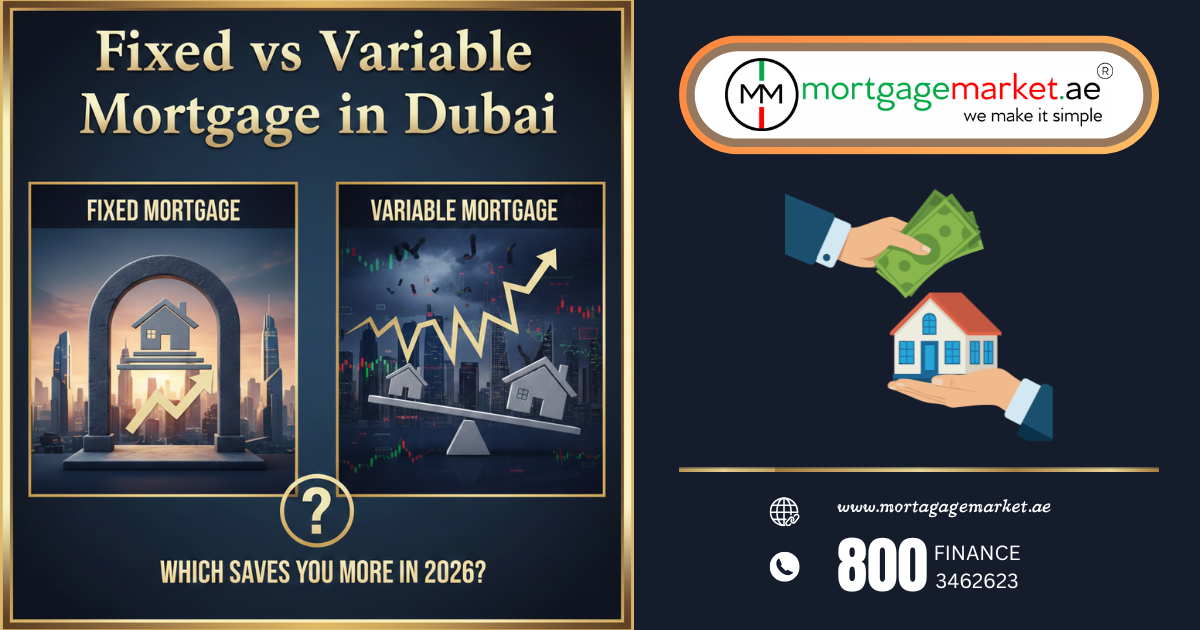
Fixed vs Variable Mortgage in Dubai: Which One Actually Saves You More in 2026?
BY THE MORTGAGE MARKET EXPERT TEAM
Choosing.....
Dubai Property Market 2026: Why Long-Term Renters Are Switching to Mortgages
In 2026, rising rents and stabilized EIBOR UAE rates are prompting.....

UAE Mortgage Rates 2026: Expert Interest Rate Forecast & EIBOR Trends
Discover the latest UAE mortgage rates in 2026 and how EIBOR.....

Buyout Mortgage Magic: Instantly Find Your Limit
At the center of Dubai’s vibrant property market—where vision collides with creativity—hides a valuable weapon.....

Top tips on how to secure a mortgage in Dubai for expats
Securing a mortgage in Dubai as an expat can feel like navigating a maze—thrilling but.....

EIBOR as on 03 Feb 2026: 1 MONTH: 3.65% | 3 MONTH: 3.60% | 6 MONTH: 3.55% | 1 YEAR: 3.72%